


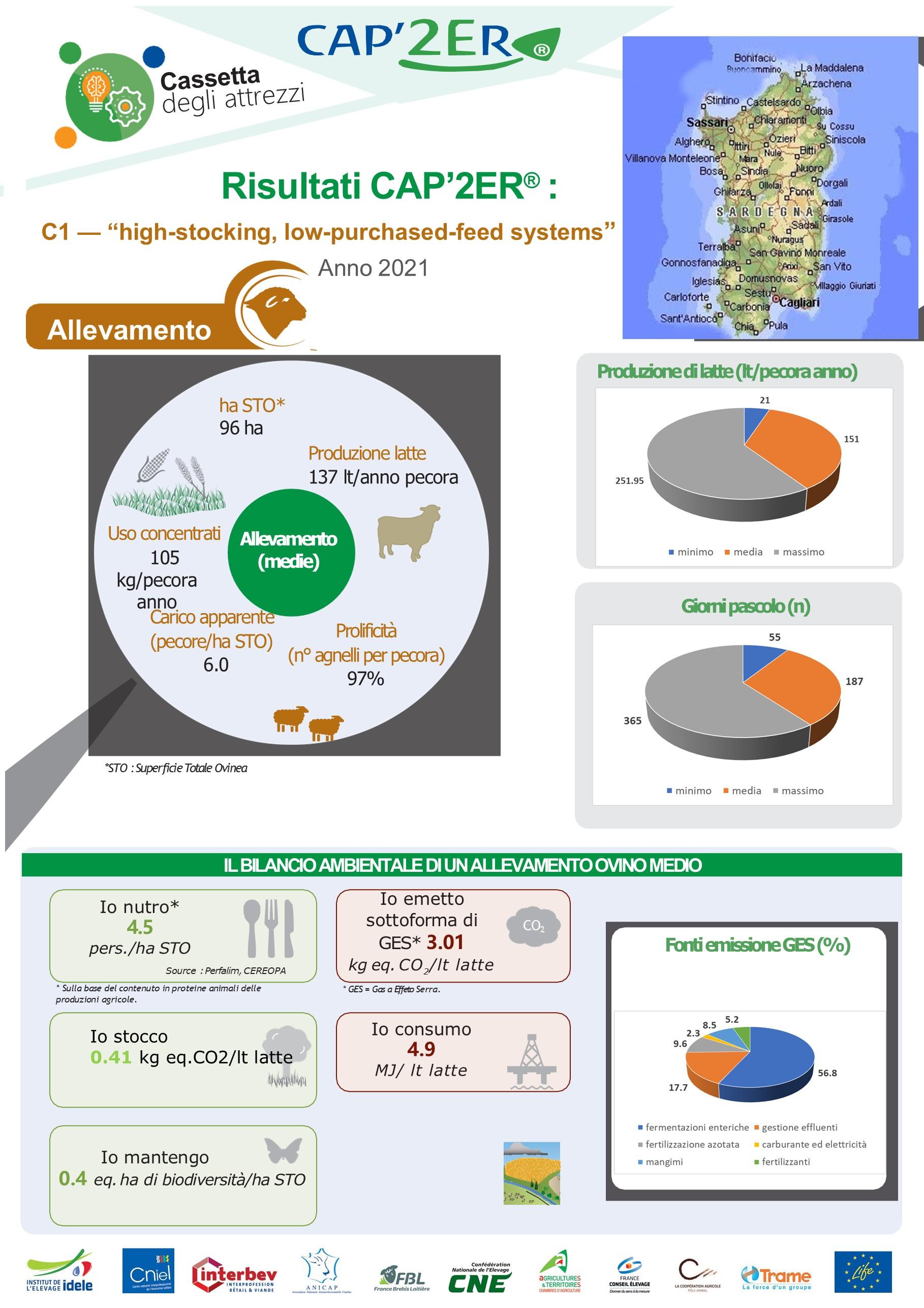
How does my farm compare with others in terms of carbon footprint? To help Italian dairy sheep farmers answer that question, LIFE Green Sheep partners have published four CAP’2ER® reference sheets based on environmental assessments of farms in Sardinia (2021 data).
Four sheets, one toolbox
The sheets are part of the project’s “toolbox” (Cassetta degli attrezzi). One presents the average results for the 102 Italian farms assessed with CAP’2ER®; three others present results for each of the main farming systems identified:
- Italy All Systems
- Italy system_high-stocking, low-purchased-feed systems
- Italy system_Productive, high-input systems
- Italy system_Pastoral, lower-stocking systems
Each sheet combines technical indicators (milk yield, prolificacy, concentrate use, grazing days, energy use) with the farm’s environmental balance: greenhouse gas emissions, carbon storage, energy consumption, biodiversity maintained and the number of people fed per hectare. A blank column lets farmers and advisers enter their own figures and compare them with the reference values.
A tool for advisers and farmers
These benchmarks feed the European observatory of environmental and sustainability performance built by LIFE Green Sheep. They are designed as a starting point for dialogue between farmers and advisers, to identify the most relevant levers on each farm.
LIFE Green Sheep in Italy: global results from Sardinian dairy sheep farms.
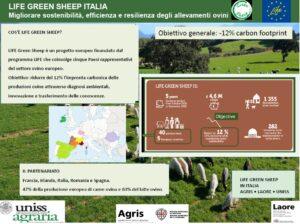
This presentation summarises the work carried out in Italy by AGRIS, LAORE and the University of Sassari (UNISS) within LIFE Green Sheep, a European LIFE project bringing together five countries that account for 47% of EU sheep meat and 63% of EU sheep milk production, with the goal of cutting the carbon footprint of sheep products by 12%. In Sardinia, 35 technicians carried out 102 CAP’2ER® environmental assessments on dairy sheep farms, covering more than 44,000 animals and 8,900 hectares (2021 data). IOn average, the gross carbon footprint of the milk is 3.7 kg CO₂eq per kg of fat- and protein-corrected milk, mainly from enteric fermentation and manure management. Carbon sequestration in grasslands offsets around 31% of emissions, bringing the net footprint down to 2.7 kg CO₂eq/kg, while the farms also contribute to biodiversity maintenance. The large variability between farms points to clear room for improvemen