


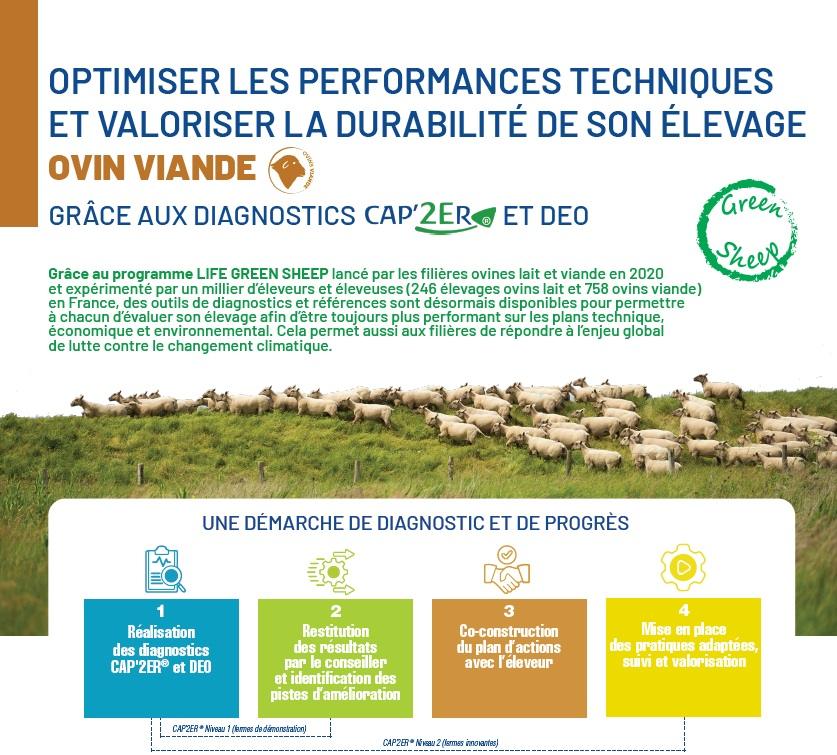
In France, around a thousand sheep farmers took part in LIFE Green Sheep: 758 meat sheep farms and 246 dairy sheep farms. Their results are now available in two information sheets, one for meat and one for dairy sheep, and twelve reference sheets by farming system, so that every farmer can assess their farm and identify ways to improve its technical, economic and environmental performance.
A diagnostic and step-by-step approach
French farms followed a four-step approach: an assessment with CAP’2ER®, for the environmental footprint, and DEO, for the overall sustainability of the farm; a presentation of the results by the adviser to identify areas for improvement; an action plan built with the farmer; and the implementation and monitoring of the chosen practices. Demonstration farms carried out a CAP’2ER® level 1 assessment, while innovative farms went further with a level 2 assessment and a carbon plan monitored over five years.
Meat sheep: a footprint driven by the flock
On the 758 meat sheep farms assessed (2021 data), gross emissions average 43.1 kg CO₂ eq. per kg of lamb carcass. Enteric fermentation accounts for about two-thirds of these emissions, followed by manure management (13%) and purchased feed (8%). Thanks to grasslands and hedges, farms store on average nearly 1.5 tonnes of CO₂ eq. per hectare each year and maintain biodiversity on their land. Each farm feeds on average 174 people a year.
It is therefore no surprise that more than half of the measures chosen by farmers in their carbon plans concern the flock: better health management, better reproductive performance, fewer unproductive animals, faster lamb growth and better genetics.
Dairy sheep: feeding at the heart of action plans
On the 246 dairy sheep farms assessed, gross emissions average 2.91 kg CO₂ eq. per litre of corrected milk. Enteric fermentation accounts for just over half of emissions, and purchased feed for 15%, a higher share than in meat farms. Farms store on average around 1.25 tonnes of CO₂ eq. per hectare and each feeds about 500 people a year.
Feeding is the first lever mentioned in action plans (43% of measures): more grazing, fewer feed purchases, more productive grasslands, better forage quality and less imported soya.
Encouraging results on innovative farms
On the innovative farms, the action plans are expected to:
- reduce greenhouse gas emissions by an estimated 12% on meat farms and 10% on dairy farms;
- cut fossil energy use per unit of product by 16% and 13% respectively;
- bring a potential economic gain of around €21 to €22 per ewe.
These averages hide wide differences between farms, but they confirm that lower emissions and better results can go hand in hand. Two farmers bear witness to this. In the Allier, a meat sheep and crop farmer has sown legumes and installed a barn dryer to produce quality forage, which has sharply reduced his concentrate use. A dairy farm expects to save several thousand euros a year on concentrates by grazing more, without losing milk, and to reduce its carbon footprint per litre.
Twelve reference sheets by farming system
To help farmers and advisers compare their results with farms like their own, twelve reference sheets present the CAP’2ER® results by farming system: [list of systems to add]. Each sheet combines technical, economic and environmental indicators, with a blank column to enter the farm’s own figures.
👉 [Download the information sheets and the twelve reference sheets]
Dairy Systems
Demonstrative farms results_References_all systems
Demonstrative farms results_References_PA_livreurs transhumants
Demonstrative farms results_References_PA_livreurs non transhumants
Demonstrative farms results_References_PA fromagers
Demonstrative farms results_References_NO_zone pastorale
Demonstrative farms results_References_NO_zone herbagère
Meat Systems
Demonstrative farms results_References_All systems
Demonstrative farms results_References_Semi-intensive (fourragers)
Demonstrative farms results_References_Semi-extensive lowland (herbagers plaine)
Demonstrative farms results_References_Semi-extensive highland (herbagers pasto))
Demonstrative farms results_References_Intensive (bergerie)
Demonstrative farms results_References_Extensive (pastoraux)