


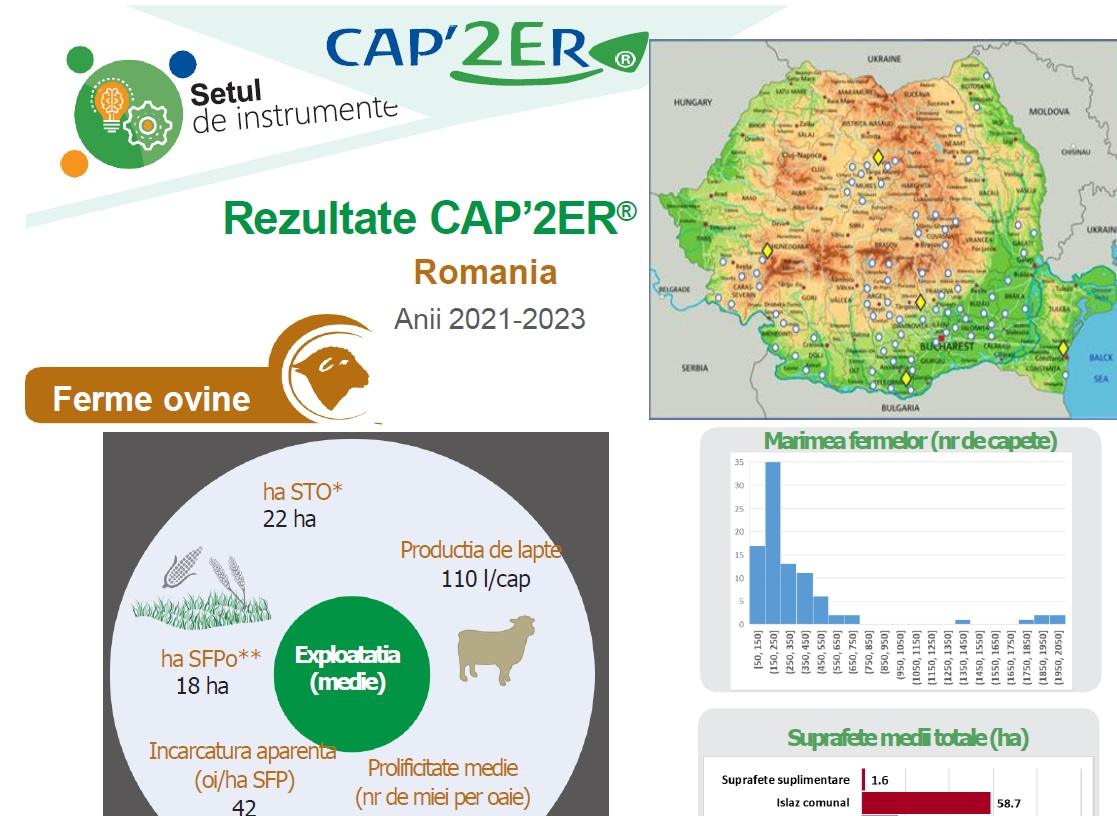
What is the carbon footprint of a Romanian sheep farm, and where are the levers for improvement? To answer these questions, LIFE Green Sheep partners have published a CAP’2ER® reference sheet based on the environmental assessment of 92 sheep farms across Romania, using data collected between 2021 and 2023.
A portrait of Romanian sheep farming
The sheet is part of the project’s toolbox (Setul de instrumente). It first describes the average farm assessed: a small farm area of around 22 hectares dedicated to sheep, a flock that in most cases numbers between 50 and 450 head, an average milk yield of 110 litres per ewe and a prolificacy of 108%.
What stands out is the central place of grazing. Ewes graze on average more than 300 days a year, often for most of the day. Farms rely heavily on communal pastures (islaz), which make up a large share of the land they use. Concentrate use stays moderate, at around 110 kg per ewe per year, less than half of it purchased.
Environmental balance of an average farm
On average, Romanian farms emit 4.46 kg CO₂ eq. per litre of standardised milk. Enteric fermentation accounts for more than 70% of these emissions, followed by manure management (around 14%) and purchased feed (around 10%). The emissions linked to fuel, electricity and fertilisers remain very low.
The pastures and grasslands used by the flocks store 1.43 kg CO₂ eq. per litre, which brings the net carbon footprint down to 3.06 kg CO₂ eq. per litre. Romanian farms also stand out for the biodiversity they maintain, almost 4 equivalent hectares of biodiversity per hectare, and for a low nitrogen surplus. Each hectare feeds around 16 people.
The relatively high footprint per litre is mainly linked to modest milk yields: the emissions of the flock are spread over a smaller volume of milk. Here again, results vary widely between farms, from about 1.5 to 6.5 kg CO₂ eq. per litre, which shows there is room for improvement. Improving animal performance, feed quality and flock management are key levers to produce more milk with a lower footprint per litre, while preserving the benefits of extensive grazing.
A tool for advisers and farmers
As in the other partner countries, a blank «Here I am» column lets farmers and advisers enter their own results and compare them with the average, minimum and maximum values. These references feed the European observatory of environmental and sustainability performance built by LIFE Green Sheep.
👉 [Download the CAP’2ER® reference sheet for Romania]